
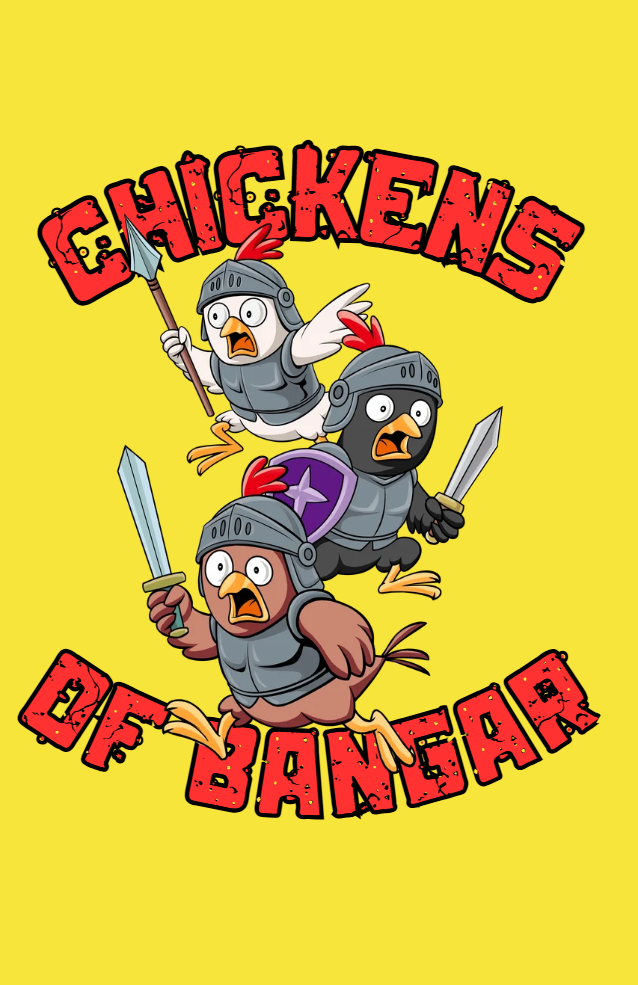
In ancient times long past, the land of Bangar was plagued by hordes of rampaging chickens. Led by clever, and ruthless poultry generals, the armies clashed over resources. Land, water, feed, all necessary to the survival of their flock, and their large fighting forces. Take command of one of these armies in epic battles across the lands of Bangar. Order your chicken cavalry, infantry, and spearchickens to take and hold territories across the land. Will you win, or will your forces fall to one of the opposing generals?
For 2-4 players and appropriate for most ages. 5 minutes to learn and games can last between 20 minutes and several hours.
Retail: $30.00
Pick up a copy here:
Setup
The Board: The game board is segmented into territories which are marked with a value from 1 to 4. This designates the point value of that territory as well as the maximum number of units that can be placed there by each player for attack or defense. It is also marked with the number of levies that can be earned when capturing that territory.
If you are playing a 3-player game, the bottom 2 territories marked with a value of 3 will not be used. Mark these neutral with a coin or other marker. If you are playing with 4 players, the two bottom territories with a value of 4 will not be used. A 2-player match can use all territories on the board.
Chickens: There are four chicken armies included, and each contains the maximum number of soldiers a player can have at any time. There are 11 territory markers, 5 infantry (swords), 4 pikemen (spears), and 3 cavalry (shields). Each player will select an army. Note: If you wish to extend the play time in a 2-player game, each player can select two different armies, doubling the total number of troops each player has.
Dice: The dice are shared among the players. During combat, the players will decide which color represents their units during the rolls.
Claiming Initial Territories: Choose who goes first however you wish. A die roll, the eldest, youngest, or the person with the best chicken costume. That player will claim a territory by placing at least one unit on the board, up to the maximum value of the territory, along with a blank territory chicken marker. For example, if the territory has a value of 2, the player can place up to two of any of their chickens on that space. This continues around the table until all units are placed and/or all territories are claimed. If there are no more territories to claim and any players have extra units, they will take turns placing them on their claimed territories until they run out. Optional rule: Players may choose to initially hold some units in reserve, not placing them on the board and holding them in a reserve pool to be selected as levies should they win a battle.
Win Conditions
The game ends if there is only one player remaining with any units left on the board, or there are no more moves that can be made. The last player standing is the winner. If there is a draw, or the game ends with more than one player having territories on the board, the point values of the territories (max units) are added and the person with the highest score wins. If there is a tie, then count remaining units and add their value to the score as such: Infantry worth 1 each, spears worth 2, and cavalry worth 3.
Turns
Each player will take turns around the battlefield clockwise from the starting player. During your turn you may perform one of each of the following actions.
- Attack: You may attack an adjacent territory to one of your own by moving a number of units, up to the maximum territory value for the territory you are attacking. Leave any remaining troops, and your territory marker in your original territory.
- Reinforce: You may move any number of units from one of your territories, to an adjacent one, up to the maximum unit value of the destination territory.
Combat
At the start of combat both players in the contested territory select different colored die for each unit they have in the field, and clearly indicate which color goes with each of their units. Once declared, each player will choose to fight (roll their die), or retreat to an adjacent territory they own. If they do not own an adjacent territory, retreat is not an option.
When the die are rolled, successes are counted, and that number of units are removed from the opposing army and placed in the reserve pool. Combat is simultaneous, so it is possible for units to succeed, but also be removed from combat. For example, if each player has three units, and both have two successes, they will each have one unit remaining after the fight. Combat continues until there is a victor, or one player retreats. If all units are eliminated without a clear victor, the original owner of the territory retains ownership.
If there is a victor, they can claim levies (reinforcements) from one of the three unit types listed in the territory if they have that number of units available in their pool, up to the maximum number of units allowed in the territory. For example, if a player takes a territory with a value of 4, and they have only one unit left after combat ends, they may select 3 infantry, 2 spears, or 1 cavalry if they have those units in their reserve pool. If they only have 2 infantry in reserve, they can only reinforce with 2.
Success is determined with the following results.
- Infantry succeeds on a roll of 6
- Pikechickens succeed on a roll of 5 or 6
- Cavalry succeed on a roll of 4, 5, or 6